
 BanditAI
Form 944 for 2026: Employer’s Annual Federal Tax Return
Form 944 is an annual IRS tax return that eligible small employers use to report federal income tax withheld
and Social Security and Medicare taxes when their annual employment tax liability is $1,000 or less.
By Charles Hardy | Last Updated: November 23, 2026
Key Takeaways
- Form 944 is an annual tax return for eligible small employers with $1,000 or less in annual employment tax liability.
- The 2026 Social Security wage base is $184,500.
- The 2026 Form 944 deadline is February 1, 2027, or February 10 for eligible employers.
- Semiweekly depositors must file Form 945-A.
- Eligible employers may qualify for IRS automatic penalty relief (AEP).
What is Form 944?
Form 944, Employer’s Annual Federal Tax Return, is designed for small employers whose annual liability for Social Security, Medicare, and withheld federal income taxes is $1,000 or less. Eligible employers file Form 944 once a year instead of filing quarterly Form 941 to report their employment taxes.
If you’re a new business owner, the IRS generally identifies your employment tax filing requirement when you apply for your Employer Identification Number (EIN). Your IRS notice will indicate whether you need to file Form 944 annually or Form 941 quarterly.
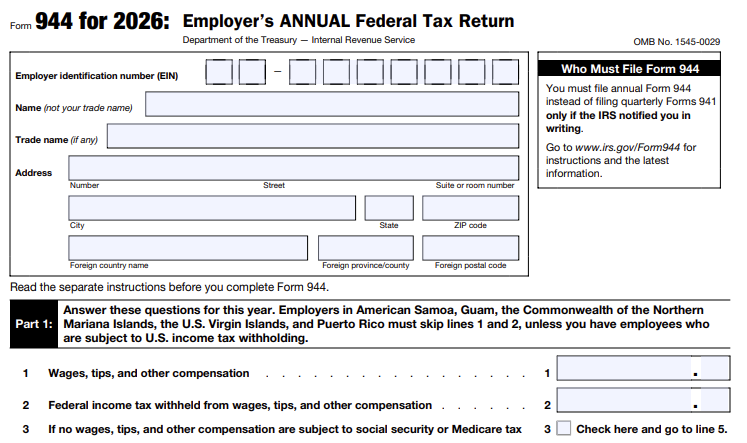
As a small business owner, you must file a Form 944, even if you have no taxes to report. If your business has closed or stopped paying wages, you will have to file a final return for the year by checking the box in line 14 on Form 944.
What’s new in Form 944 for 2026?
The IRS has introduced several updates and reminders for employers filing Form 944 for 2026. Here are the important changes to know:
Updated Social Security Wage Base for 2026
- The Social Security wage base has increased to $184,500 for 2026.
- The Social Security tax rate remains 6.2% for both employers and employees.
- The Medicare tax rate remains 1.45% for both employers and employees, with no wage limit.
Updated Social Security and Medicare Thresholds for Household and Election Workers
For the 2026 tax year:
- Household employers must pay Social Security and Medicare taxes if they pay a household employee $3,000 or more in cash wages during the year.
- Social Security and Medicare taxes apply to election workers paid $2,500 or more in cash or equivalent compensation.
Automatic Penalty Relief for Eligible Form 944 Filers
- Beginning in July 2026, the IRS introduced the Automatic Exemption from Penalty (AEP) program, replacing the previous First Time Abate (FTA) relief.
- Eligible employers may automatically qualify for relief from failure-to-file, failure-to-pay, and certain failure-to-deposit penalties.
- Generally, employers must have timely filed their returns and paid taxes due for the previous three years to qualify. Employers who previously filed Form 941 may qualify based on their previous 12 quarters of filing and payment history.
What information is required to fill out Form 944 for 2026?
Before starting your 944 filing, make sure you have the following information ready to ensure a smooth process:
- Your EIN and other business information
- Total number of employees
- Total payments made to your employees
- Federal income tax and FICA tax withheld
- Balance due if any
- Deposit schedule and tax liability for the year
Need to know more on this? Check our article for additional information and instructions for completing Form 944.
When is Form 944 due for 2026?
Form 944 is an annual employment tax return generally due by January 31 of the following year. If the due date falls on a weekend or federal holiday, the deadline moves to the next business day.
For the 2026 tax year, the regular January 31, 2027, deadline falls on a Sunday. Therefore, the Form 944 filing deadline is February 1, 2027.
However, if you deposited all your taxes on time and in full, you have until February 10, 2027, to file your return.
Which type of employer cannot use Form 944?
If you are an employer of the below-mentioned categories, then you are not eligible to use Form 944.
- Household employers - If you are an employer of household employees you cannot use Form 944. To know more, check Publication 926 and Schedule H (Form 1040).
- Agricultural employers - If you have only agricultural employees, then you aren’t eligible to file this form. For more information, see
Form 943 and Publication 15. - Employers who received notification from the IRS - Use Form 944 only if you requested and received written confirmation from the IRS that your filing requirement was changed.
- Employers who did not receive notification from the IRS - If the IRS hasn't notified you to file Form 944, don’t use Form 944 to report the payroll taxes withheld.
How is Form 944 different from Form 941?
Both Form 941 and 944 are used to report payroll tax information to the IRS. They only differ in terms of business tax liability and reporting frequency.
Form 941 is used by businesses to report income taxes, Social Security, and Medicare taxes withheld from the employee's paycheck during the year. Form 944 is used to report payroll tax for the business if its annual tax liability is less than $1,000 over the year. Similarly, the deadline for filing Form 941 falls on every quarter, whereas the deadline for filing Form 944 is once a year (i.e., January 31).
Click here to learn about Form 941 vs 944 in detail.
When to complete 945-A on Form 944?
You must complete and attach Form 945-A to Form 944 if you are a semiweekly schedule depositor or become one after accumulating $100,000 or more in tax liability on any day during a deposit period.
- Tax Liability Below $2,500: You generally don't need to deposit the tax and may pay it with Form 944.
- Tax Liability of $2,500 or More: You are generally required to deposit your taxes according to your monthly or semiweekly deposit schedule.
- Semiweekly Depositors: You must complete Form 945-A to report your daily tax liabilities instead of completing the monthly liability section in Form 944.
- $100,000 Next-Day Deposit Rule: Monthly schedule depositors who accumulate $100,000 or more in tax liability on any day must switch to the semiweekly deposit schedule.
What is the penalty for filing Form 944 late?
If you fail to file or pay Form 944 by the applicable deadline, the IRS may impose the following penalties:
- Late Filing Penalty: 5% of the unpaid tax for each month or part of a month the return is late, up to 25%.
- Late Payment Penalty: Generally 0.5% of the unpaid tax for each month or part of a month the payment remains overdue, up to 25%.
- Late Deposit Penalty: Ranges from 2% to 15% of the unpaid deposit, depending on how late the deposit is.
For more detailed information about 944 Penalties, click here.
How to file tax Form 944?
When it's time to submit Form 944 and make tax payments, you have a few options to choose from. You can either file Form 944 electronically and pay your taxes online or mail your form and payments to the IRS.
However, the IRS recommends businesses e-file Form 944 for faster and more secure processing. In order to e-file Form 944 and manage your tax payments, you must get started with TaxBandits, an IRS-authorized e-file provider.
TaxBandits enables you to quickly file your returns with time-saving features, from built-in error checks based on the IRS Business Rules to automated tax calculations. Your 944 filing includes Form 945-A, 8453-EMP, and 944-V.
Click here to learn how to file Form 944 online using TaxBandits.
Ready to File Form 944 With Confidence
Simplify your annual employment tax filing with TaxBandits. Prepare, review, and e-file Form 944 with guided
support and built-in error checks.

