
 BanditAI
Form 941 vs 944: What's the Difference?
Form 941 and Form 944 are both used to report federal payroll taxes, including income tax withholding, Social Security, and Medicare. The key difference is filing frequency and eligibility—Form 941 is filed quarterly by most employers, while Form 944 is filed annually and applies only to small employers who are notified by the IRS.
By Charles Hardy | Last Updated:
April 27, 2026
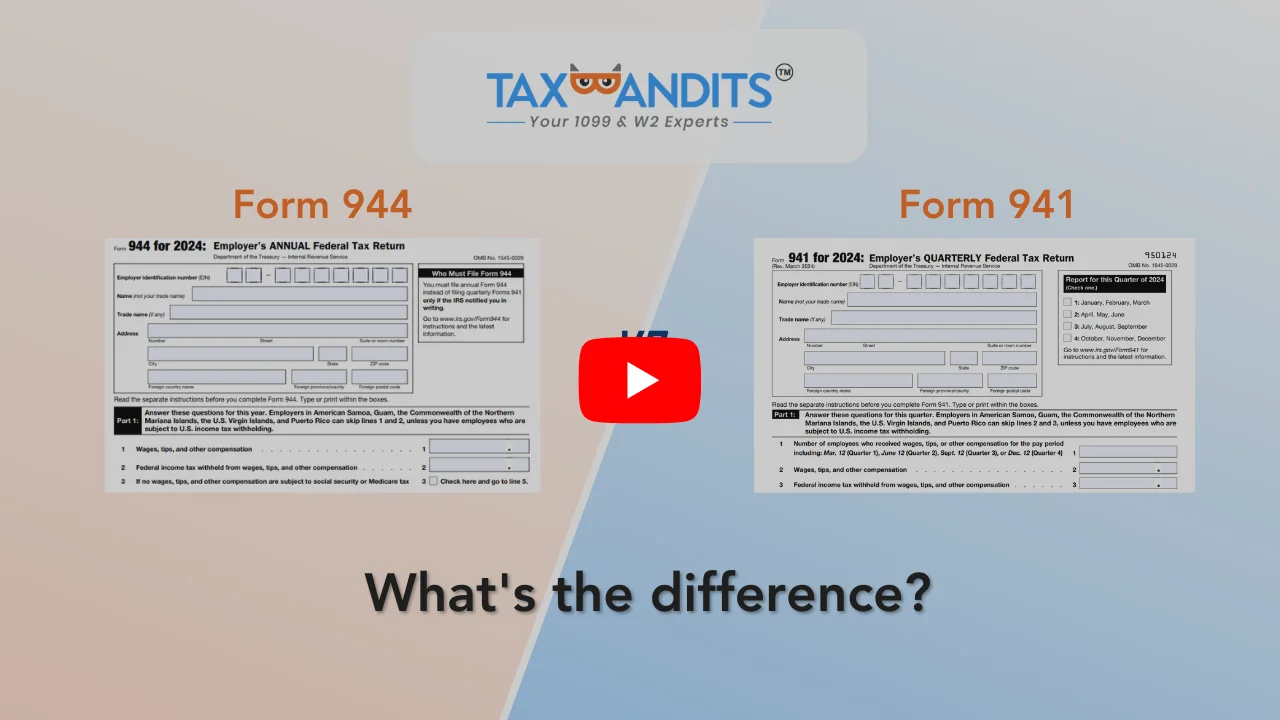
Key takeaways
- Form 941 is filed quarterly to report payroll taxes for most employers.
- Form 944 is filed annually and is designed for small employers with lower tax liability.
- You cannot choose freely—Form 944 is only filed if the IRS notifies you.
- Both Form 941 and 944 report the same taxes, but differ in filing frequency and eligibility.
What is the difference between 941 and 944?
Form 944 is the annual equivalent of the quarterly Form 941. Small business employers who are notified by the IRS are required to file Form 944 annually (once a year) instead of filing Form 941 quarterly (four times a year).
Employers use both Form 941 and 944 to report employment taxes, which include federal income tax withheld and Social Security and Medicare taxes withheld from employees. Although both forms report the employment taxes, their filing requirement is different based on the employer's tax liability.
Refer to the table below for a detailed explanation of the differences between 941 and 944.
| Form 941 | Form 944 | |
|---|---|---|
| Purpose | Reports payroll taxes, including income tax withholding, Social Security, and Medicare | Reports payroll taxes, including income tax withholding, Social Security, and Medicare |
| Filing Frequency | Quarterly | Annual |
| Due Dates | April 30, July 31, October 31, January 31 | January 31 |
| Eligibility |
Default for employers paying wages Employers with an estimated tax liability of more than $1,000 |
Only if IRS notifies you Small business employers with annual liability of $1,000 or less |
Who is required to file Form 941 or Form 944?
Most employers are required to file Form 941, unless the IRS has notified them to file Form 944 instead.
-
File Form 941 if you:
- Pay wages subject to federal income tax withholding, or
- Withhold Social Security and Medicare taxes
-
File Form 944 if you:
- Have been notified by the IRS to file Form 944 annually
- Typically have a lower payroll tax liability (around $1,000 or less annually)
Can You Choose Between Form 941 and 944?
No, employers cannot freely choose between Form 941 and Form 944.
The IRS determines eligibility for Form 944 and will notify you if you qualify. If you want to switch forms, you must request approval from the IRS.
- Currently, If you're required to file Form 944, but your estimated tax liability is more than $1,000, you may be eligible to update your filing requirement to Form 941.
- If you're an employer required to file Form 941, but your estimated tax liability will be $1,000 or less for the tax year, you may be eligible to switch to Form 944.
Click here to learn how to request the IRS to change your filing requirement.
How do you file Form 941 and Form 944?
The IRS allows employers to file Form 941 and Form 944 either electronically (e-file) or by mailing paper forms.
However, the IRS strongly encourages electronic filing, as it is faster, more accurate, and provides confirmation once the return is accepted. Electronic filing also allows you to submit payments securely along with your return using Electronic Federal Tax Payment System (EFTPS).
For businesses managing payroll taxes regularly, using an IRS-authorized e-file provider can simplify the process by:
- Reducing errors
- Ensuring compliance with filing requirements
- Providing real-time status updates
Easier Way To File!
If you're looking for a faster and more reliable way to file, you can e-file Form 941 and 944 online with TaxBandits and manage your filings in one place.