
 BanditAI
IRS Form 941 Instructions for 2026
Every quarter, employers must file Form 941 to report wages and federal payroll taxes to the IRS.
To avoid major mistakes, learn the Form 941 instructions for 2026 and know how to fill out IRS Form 941.
Table of Content:
Complete Business Information
First, complete your basic details in
-
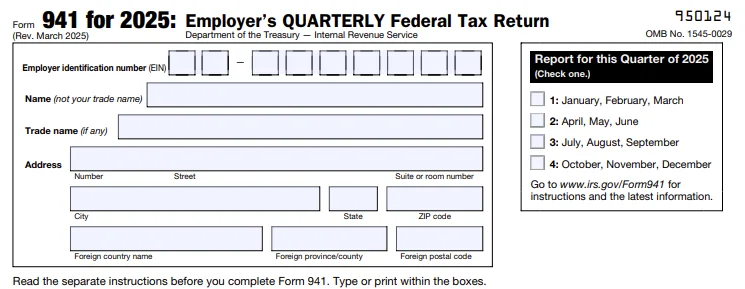
Box 1: Entering Employer Details
In box 1, enter the EIN, name, business name, and address.
-
Box 2: Choosing Quarter
In box 2, choose a quarter for which Form 941 is being filed.
For example, if you are filing the Form for the first quarter of the 2026 tax year, put an “X” in the box next to “January,
February, March.”
Part 1 - Questions for the quarter
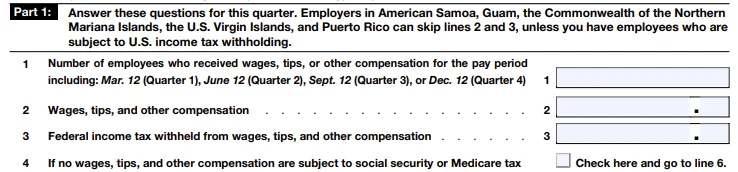
Part 1 reports the Number of employees, their wages, and the federal income taxes withheld from their paychecks.
Part 1 consists of 15 lines where each line is explained in detail with the information that must be entered.
-
Line 1
Enter the number of employees, who got wages, tips, or other pay in the particular quarter
-
Line 2
Enter the complete wages, tips, paid and other pay to your employees
-
Line 3
Enter the federal income tax withheld from the employee’s paycheck
-
Line 4
Check this box if wages are not subject to social security and medicare tax. And if it doesn't apply, please skip this line
-
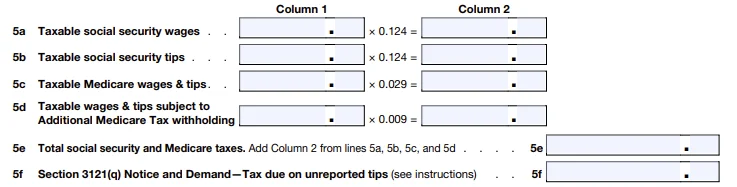
Line 5a : Taxable Social Security Wages
Line 5a = Column 1 x 0.124 = Column 2Enter the tax due that you have received from the Section 3121(q) Notice and Demand
-
Line 5b : Taxable social security tips
Enter the tips reported for all your employees during the quarter
Line 5b = Column 1 x 0.124 = Column 2 -
Line 5c : Taxable Medicare wages & tips
Enter the wages, tips, that are subject to medicare tax
Line 5c = Column 1 x 0.029 = Column 2 -
Line 5d : Taxable wages & tips subject to Additional Medicare Tax withholding
Enter all the taxable wages & tips subject to Additional Medicare Tax withholding
Line 5d = Column 1 x 0.009 = Column 2 -
Line 5e : Total social security and Medicare taxes
Sum of Column 2 from Lines 5a, 5a(i), 5a(ii), 5b, 5c and 5d.
Looking to Calculate Taxes to be reported on Form 941?
Use our Free Payroll Tax Calculator to compute Federal Income tax, Social Security, and Medicare taxes that is to be withheld from each employees paycheck.
-
Line 5f : Section 3121(q) Notice and Demand—Tax due on unreported tips
Enter the tax due that you have received from the Section 3121(q) Notice and Demand

The IRS issues Section 3121(q) Notice and Demand to employers advising them to report tips that their employees have failed to report. Employers aren’t liable for their share of social security and medicare taxes unless the employer receives this notice.
-
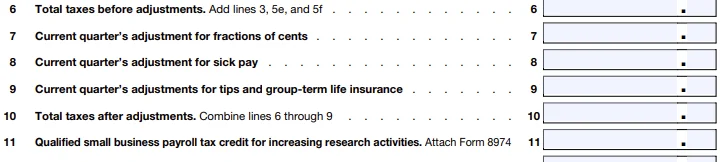
Line 6 : Total taxes before adjustments
Enter the sum of Line 3, 5e, and 5f
-
Line 7 to 9 : Tax Adjustments
Enter the Adjustment for a fraction of cents (Line 7), sick pay (Line 8), tips and group life insurance (Line 9)
-
Line 10 : Total taxes after adjustments
Enter the sum of line 6 to line 9
-
Line 11 : Qualified small business payroll tax credit for increasing research activities
Enter the amount calculated in Form 8974 and attach.
Form 8974 is used to determine the amount of credit that can be claimed for the increasing
research activities.
-
Line 12 : Total taxes after adjustments and nonrefundable credits
To get this amount, Subtract line 11 from line 10 as the amount on line 12 can’t be less than zero.
-
Line 13 : Total deposits for this quarter, including overpayment applied from a prior quarter and overpayments applied from Form 941-X, 941-X (PR), or 944-X filed in the current quarter.
-
Line 14 : Balance due
If the amount you entered in line 12 is more than the amount entered in line 13. Enter the difference and refer to the instructions below:
- You can make federal tax deposits for the amount shown on line 14 using EFW.
- If you are a monthly schedule depositor and making a payment for the amount shown on Line 14, you can pay by EFW, EFTPS, Credit or debit card, check, money order.
- File Form 941-V, if you prefer to pay the balance due using check or money order.
- If you were unable to pay the balance due in full you can apply for an installment agreement online. To apply using the Online Payment Agreement Application, please visit IRS.gov/OPA.

Note: TaxBandits supports EFTPS Payments, where you can pay your federal taxes in a easy and secure way.
-
Line 15 : Overpayment
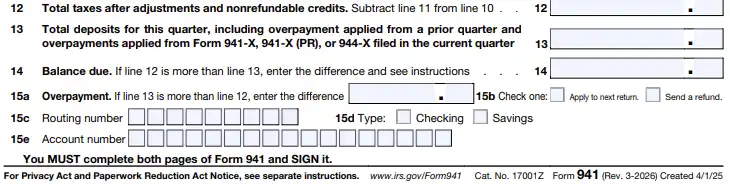
Form 941 for 2026 now includes dedicated fields (Lines 15c–15e) to collect bank account information, allowing employers to receive refunds for overpayments via direct deposit.
-
Line 15a : Overpayment
If the amount on Line 13 is more than the amount on Line 12, enter the difference on Line 15a.
- Do not enter an amount on both Line 14 and Line 15a.
- Line 15a represents the total overpayment for the quarter.
-
Line 15b : Apply to Next Return or Request a Refund
If you overpaid your taxes for the quarter, you must choose how you want the overpayment handled.
You may:
- Apply the overpayment to your next Form 941 return, or
- Request a refund
Check only one box on Line 15b.
If you:
- Don’t check a box, or
- Check both boxes,
The IRS will generally apply the overpayment to your next return.
The IRS may apply your overpayment to any past-due tax balance under your EIN, regardless of your selection.
If the overpayment amount is less than $1, the IRS will refund or apply it only if you submit a written request.
If you select “Refund” but do not complete Lines 15c–15e (Direct Deposit section), your refund may be delayed.
Direct Deposit
To receive your refund via direct deposit, you must complete Lines 15c–15e.
Direct deposit provides faster refunds, increased security, and reduced paper processing.
-
Line 15c : Routing Number
Enter your bank’s 9-digit routing number.
-
The first two digits must be:
- 01 through 12, or
- 21 through 32
- Confirm with your financial institution that direct deposits are accepted.
You should verify your routing number if:
- The routing number on your deposit slip differs from your checks
- You are depositing into a savings account that does not allow check writing
- Your checks list a different financial institution
-
The first two digits must be:
-
Line 15d : Type of Account
Select the appropriate account type:
- Checking
- Savings
Check only one box. Selecting the wrong account type may cause your deposit to be rejected.
If unsure, confirm with your financial institution.
-
Line 15e : Account Number
Enter your bank account number where the refund should be deposited.
- Maximum: 17 characters
- May include numbers and letters
- Hyphens are allowed
- Do not include spaces or special symbols
- Leave unused boxes blank
If your refund deposit amount differs from what you expected, the IRS will mail an explanation within approximately two weeks after the deposit.
Form 941 Part 2 - Deposit schedule and tax liability for the quarter
Part 2 requires information about tax liability for the quarter, whether you are a semiweekly or monthly depositor.
-
Line 16
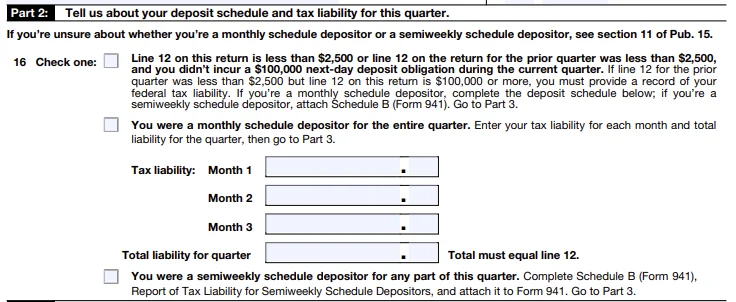
you have options to check any one of the boxes based on your tax liability.
Check box 1, If Line 12
- On your Form 941 was less than $2,500
- On your previous quarterly return was less than $2,500
- You didn’t incur a $100,000 next-day deposit obligation during the current quarter
Check box 2, If you were
- A monthly schedule depositor for the entire quarter, and enter your tax liability for each month of the quarter (Month 1, Month 2, and Month 3).
- Your total liability for the quarter must be equal to line 12 on your tax form 941.
Check box 3, If you were
- A semiweekly depositor during any part of the quarter.
- You must also enter the tax liability on Schedule B (Form 941), Report of Tax Liability for Semiweekly Schedule Depositors, and attach it along the Form 941 if you were a semiweekly depositor.
How to determine your deposit schedule
Your Form 941 deposit schedule is generally determined by your lookback period, which is based on the total payroll tax reported during the four quarters ending June 30 of the preceding year.
- Monthly schedule depositor: Deposits are generally due by the 15th day of the following month.
- Semiweekly schedule depositor: Deposit due dates depend on the day wages are paid and follow the IRS semiweekly deposit schedule.
- $100,000 next-day deposit rule: Employers that accumulate $100,000 or more in tax liability during a deposit period generally must deposit the tax by the next business day.
Form 941 Part 3 - About your business
The third portion of the 2026 IRS Form 941 collects information that will not be relevant to every business, for example, if the business is closing or is a seasonal employer. If the question does not apply to the business you are filing for, leave the field blank.
-
Line 17 : If your business has closed or you stopped paying wages
If your business was closed or you stopped paying wages in the quarter, check on line 17 and enter the final date when you paid wages.
-
Line 18 : If you are a seasonal employer and you don’t have to file a return for every quarter of
the yearIf you are a seasonal employer and don’t have to file Form 941 every quarter, then check the box under line 18.

If lines 17 and 18 don’t apply to your business, then just leave Part 3 blank and move on to Part 4.
Form 941 Part 4 - Third-party designee
Part 4 requires information about the third party designee that the employer authorizes to discuss with the IRS.
Check “Yes”, If you wish to discuss this return with the IRS and provide the designee name and phone number. Also, enter the 5 digit pin to use while talking with the IRS.
Check “No”, if you don’t wish to discuss.

Form 941 Part 5 - Signature
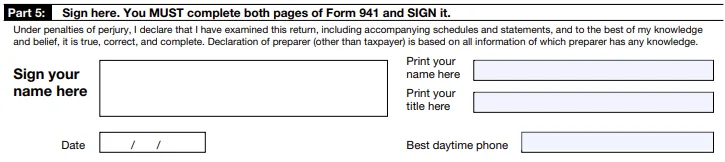
Once each and every part is completed, you are required to sign Form 941.
The following persons are authorized to sign the return for each type of business entity.
- Sole proprietorship: Individual who owns the company
- Corporation or an LLC treated as a corporation: President, vice president, or other principal officer
- Partnership or an LLC treated as a partnership: Partner, member, or officer
- Single-member LLC: Owner of the LLC or a principal officer
- Trust or estate: The fiduciary
Paid Preparers Using Only Form 941 must be
- 941 Form must be signed by a duly authorized agent of the taxpayer if a valid power of attorney has been filed.
-
If the form is prepared by the paid preparer, enter their information such as name, signature, address, PTIN, and
contact number.
- A paid preparer is someone who completes your Form 941 filing and is responsible for preparing payroll tax forms on
your behalf. - If your Form 941 is filed by a paid preparer, they have to enter their information on part 5.
What are the methods to file Form 941?
Businesses can file Form 941 on paper or electronically.
1. Paper filing
Download and complete the applicable Form 941, then mail it to the IRS address specified in the current instructions. Form 941 mailing address depends on factors such as the business location and whether a payment is included.
Keep a copy of the filed return and proof of mailing for your records.
2. E-filing
Businesses can electronically file Form 941 through an IRS-authorized e-file provider. Review the return, complete the required electronic signature or authorization process, and submit it electronically.
After submission, retain the IRS acceptance confirmation and a copy of the filed return for your records.
The IRS recommends you choose e-filing for a better, quicker, and more efficient filing process.
Get Guided Step-by-Step Instructions to Fill Out 941
You've got the instructions covered. Now make filing easier. TaxBandits guides you through the entire Form 941 filing process with the step-by-step Instructions and AI-powered support you need at every step.


Download 941 Filing Instructions
Get your guide and file accurately and on time—with confidence.
- Step-by-step line instructions
- IRS tips & deadlines
- Avoid common filing errors
Other Suggestions

Related Topics
IRS Form 941
- Form 941
- Form 941 Instructions
- Form 941 Due Dates
- Form 941 Mailing Address
- Form 941 Schedule B
- Form 941 Penalty
- Form 941 ERC
- Form 940 vs 941
- Form 941 vs 944
Revised Form 941 for 2023
Form 941 Worksheets
- Form 941 Worksheet 4 for Q3 & Q4 2021
- Form 941 Worksheet 2 for Q2 2021
- Form 941 Worksheet 1
- Form 941 Worksheets
IRS Form 941-X
Revised Form 941 for 2022
Revised Form 941 for 2021
- IRS Form 941 for Q4 2021
- Revised Form 941 for 2nd Quarter, 2021
- Form 941 Quarter 2 vs Quarter 1, 2021
- Revised Form 941 Schedule R for Q2 2021
- Revised Form 941 for 1st Quarter, 2021
Revised Form 941 for 2020
- Revised Form 941 for 2nd Quarter
- Revised Form 941 for 3rd & 4th Quarters
- Revised Form 941 Schedule R
- Revised Form 941-X