
 BanditAI
Understanding Form W-9
-
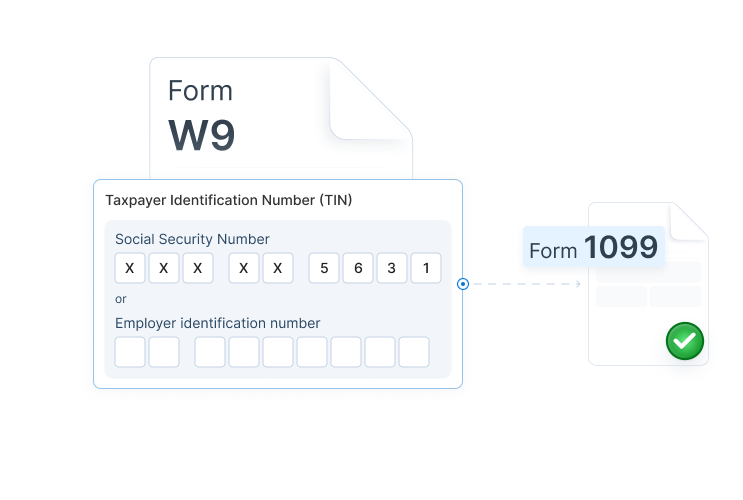
Form W9 allows payers to collect a recipient’s Taxpayer Identification Number (TIN) to report payments made to recipients on 1099 returns.
For example,
-
If you’re a business owner hiring a non-employee, such as a contractor or freelancer, you need to collect a completed W-9 from them to
file a 1099-NEC with the IRS for the payments you paid to them. -
If you're a banking software process that accounts for individual clients, you need to collect a completed W-9 from them to file 1099-MISC or
file 1099-DIV and accurately report interest or dividend payments
to the IRS.
-
If you’re a business owner hiring a non-employee, such as a contractor or freelancer, you need to collect a completed W-9 from them to
What Information Do Your Recipients Provide on Form W9?
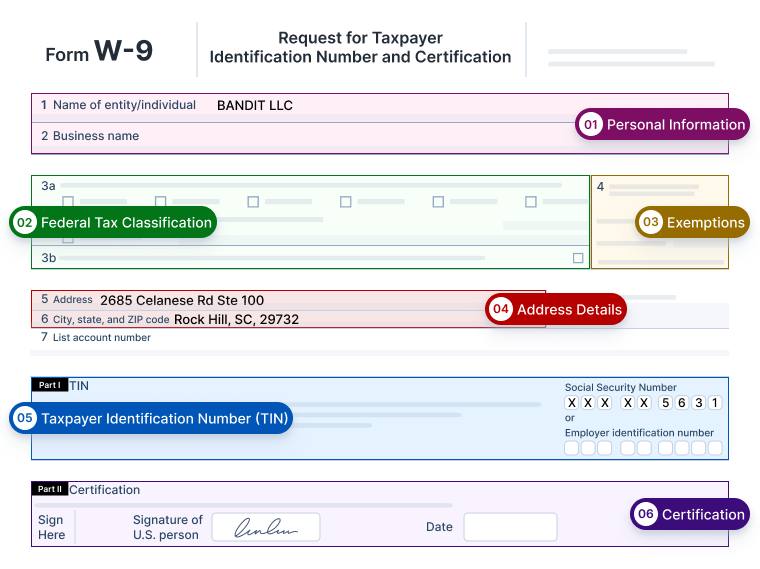
When your recipients fill out Form W-9, they must provide the following key information:
-
1. Personal Information
- Individual or entity’s legal name
- Business name or disregarded entity name (if applicable)
-
2. Federal Tax Classification
- Individual/Sole Proprietor
- S Corporation
- C Corporation
- Trust/Estate
- Partnership
- LLC (specify classification: C Corporation, S Corporation, Partnership)
-
3. Exemptions
- If exempt from backup withholding or FATCA reporting, provide the applicable codes
-
4. Address Details
- Street address, apartment/suite number
- City, state, and ZIP code
-
5. Taxpayer Identification Number (TIN)
- Social Security Number (SSN) or Employer Identification Number (EIN)
-
6. Certification
- Recipients certify that their TIN is correct (or they are waiting for one), that they are not subject to backup withholding, that they are U.S. persons, and that the FATCA exemption codes provided are correct.
- Date of signature

If you need to share your own W-9, you can easily complete, e-sign, and securely share your W-9 or W-8BEN at no cost with TaxBandits.
What Happens if a Recipient Doesn’t Provide a Completed W-9?
Form W-9 does not have a specific IRS filing deadline since it is not filed
with the IRS.
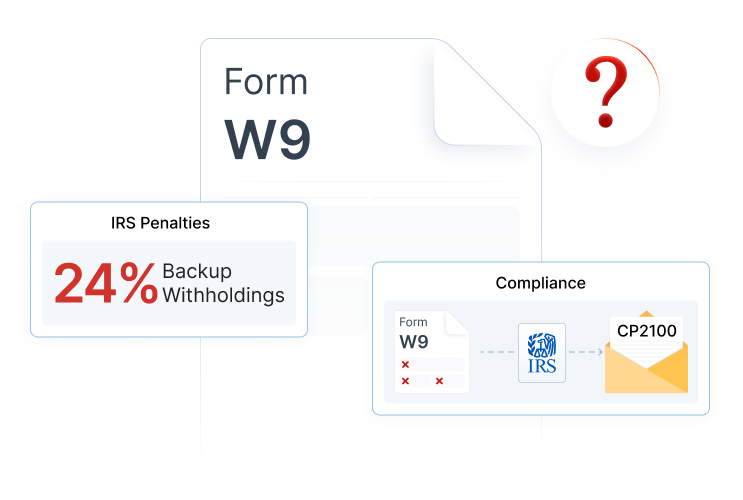
However, if your recipient doesn’t provide you with a completed W-9, it can create compliance and payment issues for you as the requester. Here’s what can happen:
- Backup Withholding: You may be required to withhold 24% of payments from the recipient until a valid W-9 with the correct TIN is received.
- IRS Penalties: Failing to collect a correct TIN can result in penalties for your business if inaccurate or missing information is reported.
- Compliance Risk and Notices: The IRS may issue a CP2100 or CP2100A notice if your filings contain missing or incorrect TINs.
Challenges in Collecting a W9 from the Recipients
Collecting W-9s sounds simple, but manual processes often lead to delays, errors, security concerns,
and compliance headaches for businesses.

Endless Follow-Ups and Delays
Requesting a W-9 turns into days (or weeks) of waiting and chasing vendors, slowing down onboarding and payments.

Incomplete or Error-Prone Submissions
When the form arrives, it’s often missing signatures, has incorrect details, or comes as an unreadable photo—creating rework and compliance risk.

Sensitive Data Shared Insecurely
W-9s are frequently sent to unsecured inboxes or attachments, exposing taxpayer information and increasing the risk of data breaches.

Compliance Anxiety and Penalty Risk
Missing or incorrect W-9 information leads to uncertainty, last-minute scrambling during the 1099 season, and potential IRS penalties if something slips through.
Put W9s on autopilot, eliminate delays, and move beyond the messy chase.

Request W9s Electronically
Turn days of waiting into minutes with electronic
W-9 requests

Setup Reminders
Automate follow-ups so vendors never slip through the cracks

Secure Dashboard
Keep track of all your recipients’ W-9s in a centralized place

TIN Validations
Catch incorrect TINs early and avoid CP2100/ CP2100A penalty notices

Integrated 1099 Filings
Sync vendor data directly into your 1099 filings for a flawless year-end.
Stop chasing W9 forms manually and reduce compliance stress—Switch to TaxBandits W-9 Manager.
Frequently Asked Questions on Form W-9
Is there any specific deadline for completing Form W-9?
Form W-9 does not have a specific IRS filing deadline since it is not filed with the IRS.
However, it’s best to complete the W-9 as soon as it’s requested to avoid delays in payments or tax reporting. Collecting W-9 forms during independent contractor or vendor onboarding helps ensure accurate information reporting and timely compliance with IRS filing requirements.
How do I fill out Form W-9?
To fill out Form W-9, enter your legal name, business name (if applicable), federal tax classification, mailing address, and your Taxpayer Identification Number (SSN or EIN). Review the certification, then sign and date the form before submitting it to the requester.
Check out our article for step-by-step instructions on how to complete Form W-9.
What is backup withholding?
Backup withholding is a federal tax requirement that requires payers to withhold 24% of certain reportable payments and remit them to the IRS when a recipient fails to provide a valid Taxpayer Identification Number (TIN) or provides incorrect information on Form W-9. Click here to learn more about backup withholding.
What is FATCA Reporting?
FATCA (Foreign Account Tax Compliance Act) is a U.S. law that helps prevent tax evasion by U.S. taxpayers who have financial accounts in other countries. Here’s what you need to know as a payer:
- Foreign financial institutions must report information about U.S. account holders to the IRS.
- Some payees are exempt from FATCA reporting. If they are, they will provide an exemption code on Line 4 of Form W-9.
FATCA reporting helps you stay compliant with IRS rules and avoid potential penalties.
Are there any changes to Form W-9 for 2026?
The IRS has made some significant changes to draft Form W-9 for 2026 that payers and recipients must be aware of before requesting or submitting W-9s.
- If you’re a U.S. digital asset broker, you must use this checkbox in Part II to certify that you are dealing with another broker that also qualifies as a U.S. digital asset broker.
- The IRS also extended transitional relief for digital asset brokers, increased the backup withholding threshold from $600 to $2,000 for many reportable payments beginning after 2025, and updated reporting rules for third-party settlement organizations (TPSOs).
Check out our latest article to know more about the changes to Form W-9.
Does Form W-9 expire?
No. Form W-9 does not have an expiration date and remains valid unless there is a change to the recipient’s identifying information, including name, address, or TIN.
A new Form W-9 should be requested only when updated information is required to ensure accurate tax reporting and compliance.