
 BanditAI
Form 941 Penalties - Late Filing, Late Payment & Failure to File
If you own and operate a business with employees, you will need to know when to deposit and file Forms 941 and 944. If you are depositing taxes late or filing your return, the IRS will
impose penalties.
By Charles Hardy | Last updated: October 07, 2026
Key Takeaways
- Missed Deadlines – The IRS may impose penalties for late Form 941 filing, payments, or tax deposits.
- Incorrect Filings – Errors, inaccurate returns, or unpaid taxes may result in penalties and interest.
- Timely Compliance – Filing accurate returns and making tax deposits on time can help avoid costly penalties.
Check out Form 941 payment and filing penalties
Penalty For Filing 941 Late
The 941 late filing penalty applies if you don't file Form 941 by the due date. The penalty incurred will be a percentage of the taxes that aren't paid on time.
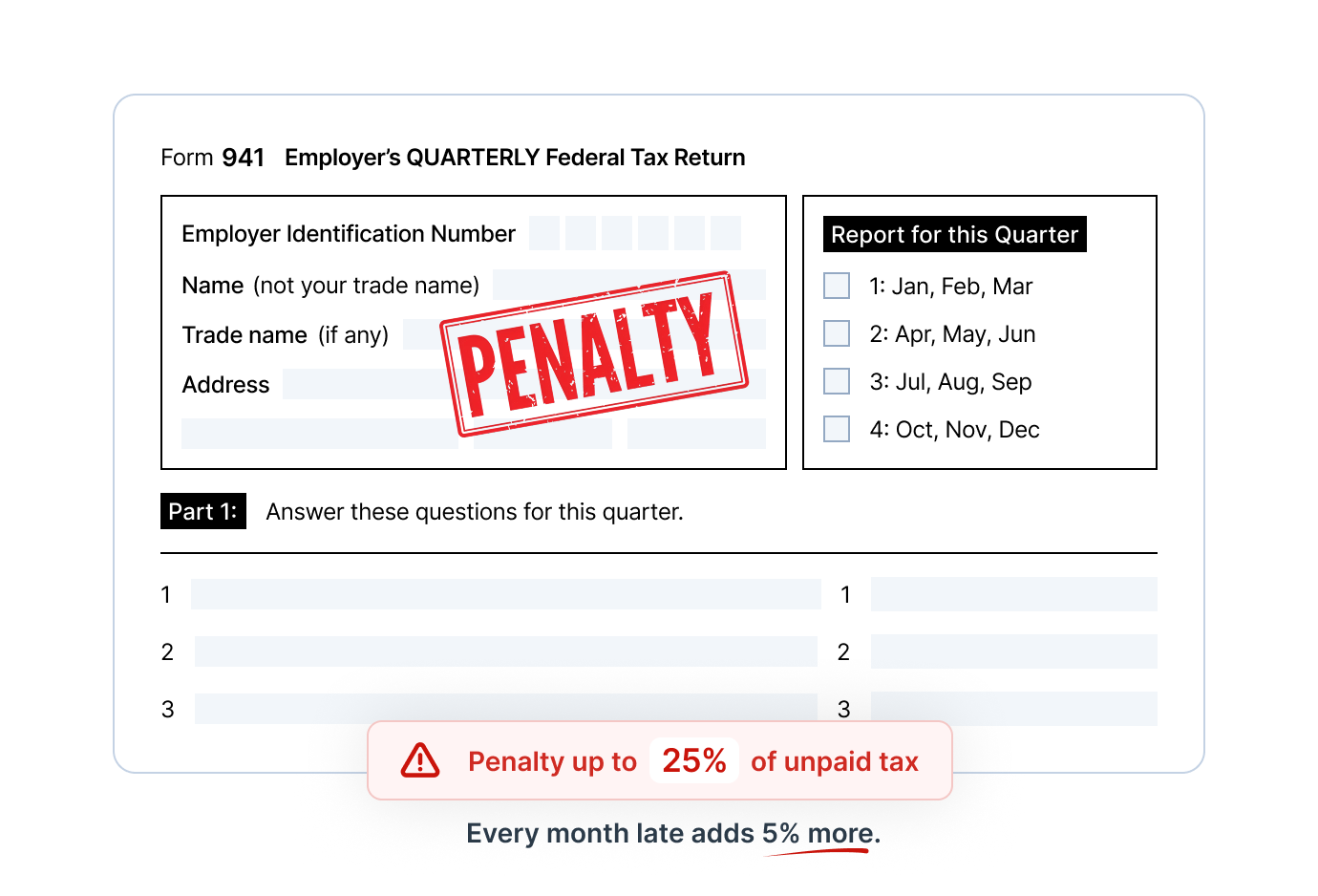
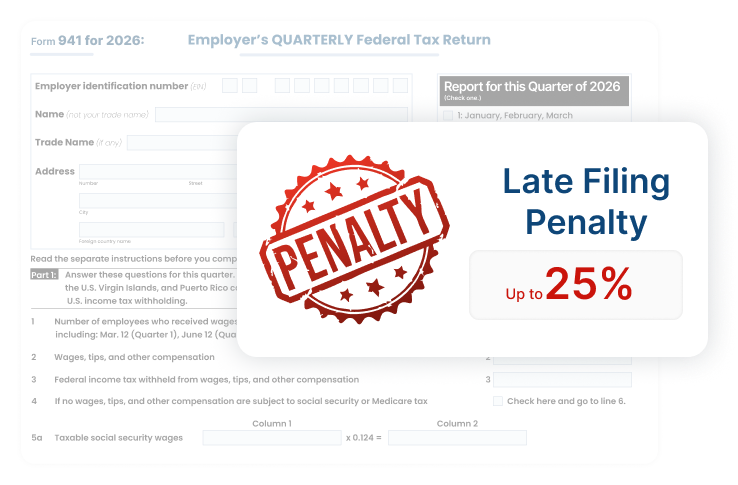
Your business will incur a penalty of 5% of the total tax amount due. You will continue to be charged an additional 5% each month the return is not submitted to the IRS for up to 5 months. The penalty will max up to 25% of the unpaid taxes.

If you fail to file Form 944 by the due date, the late filing penalty is the same as that of Form 941
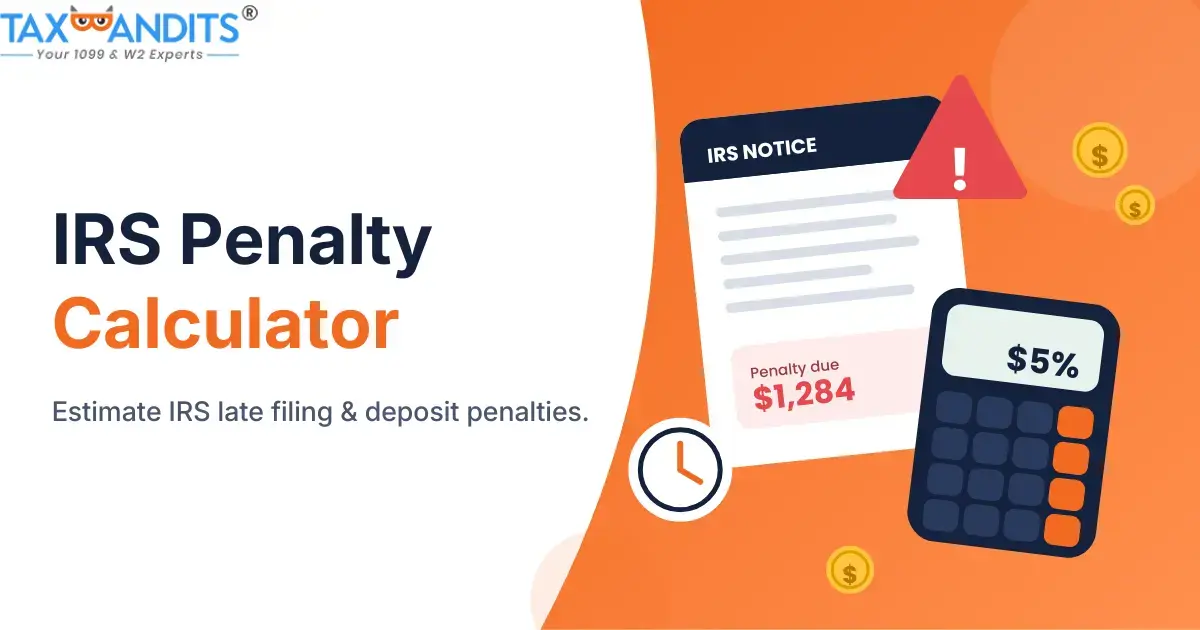
Calculate your Form 941 late filing and failure-to-deposit penalties
Use the IRS Penalty Calculator to estimate your Form 941 late filing and late deposit penalties based on how many days the
return is late and the amount of unpaid tax due.
Don't risk additional penalties— file Form 941 accurately and on time with ease.
Penalty For Late 941 Tax Deposit
The 941 late payment penalty applies to businesses that fail to make employment tax deposits:
- On or before the due date
- In the right amount and the right way
Employer-paid taxes include federal income tax, FICA (Social Security and Medicare taxes), and Federal Unemployment Tax (FUTA). The IRS will send you a notice or letter if you owe the FTD (Failure to Deposit) penalty.
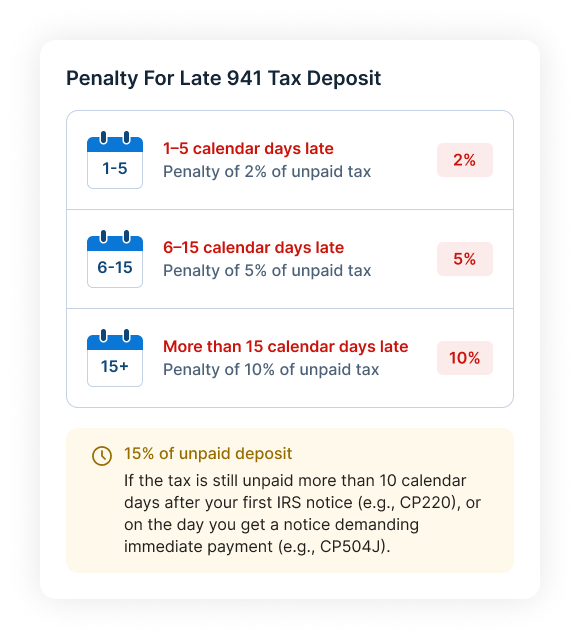
The failure to deposit penalty is calculated based on the number of calendar days your deposit is late, starting from the actual
| No. of days your payment is late | Penalty Amount |
|---|---|
| 1-5 calendar days | 2% of unpaid tax |
| 6-15 calendar days | 5% of unpaid tax |
| More than 15 calendar days | 10% of unpaid tax |
| More than 10 calendar days after receiving your first notice or letter from the IRS (for example, CP220 Notice) or the day you get a notice or letter for immediate payment (for example, CP504J Notice | 15% of unpaid deposit |
Avoid Penalties—Make Your 941 Tax Deposit on Time
Missed or late 941 tax deposits can lead to costly penalties. No worries—you can schedule and make secure tax deposits through EFTPS,
eliminating last-minute stress.
Penalty for Late 941 Payment
The failure-to-pay penalty applies when you do not pay your taxes by the due date. It is generally calculated as a percentage of the unpaid tax amount and may apply if you do not pay the tax reported on your return or fail to pay additional taxes that were not initially reported on your return.
Failure to pay the amount shown as tax on your return
If you fail to pay the tax amount reported on your return, the failure to pay penalty is
- 0.5% of the unpaid taxes for each month or part of a month the tax remains unpaid.
- The penalty won’t exceed 25% of your unpaid taxes.
If both the 941 late filing and late payment penalty are applied in the same month, the late filing penalty is reduced by the amount of the failure to pay penalty for that month, you will incur a 4.5% failure to file penalty and a 0.5% failure to pay penalty.
Failure to pay tax you didn’t report on your return
If the IRS determines that you owe additional taxes that were not reported on your return:
- You’ll receive an IRS notice stating the amount due and payment deadline.
- Typically, you have 21 calendar days to pay, or 10 business days if you owe $100,000 or more click here.
Pay your 941 taxes before they are due to avoid late payment penalties. Ensure the correct tax amount is deposited by the applicable due date.
How to Avoid Form 941 Penalties?
Avoid 941 penalties and interest with the following actions:
- File your return by the IRS deadline: Ensure you file Form 941 on time and submit it properly.
- Accurately report your tax liability: Check your calculations to ensure that your return is accurate and correctly report your tax liabilities.
- Timely Payments or Deposit of taxes: In order to avoid 941 late payment penalties, be sure to deposit or pay the taxes owed by the deadline along with your return.
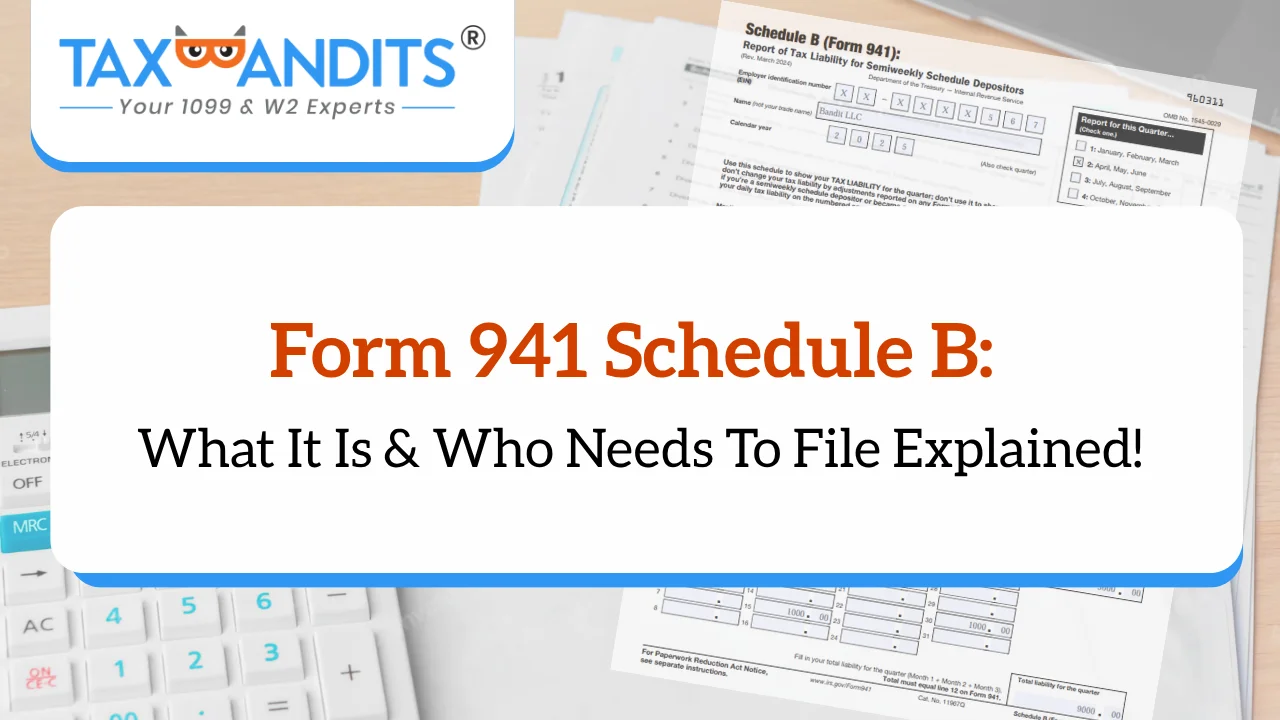
Also, make sure that you have reported your tax liability on Form 941 Schedule B without any errors.
The IRS recommends taxpayers to pay taxes online using EFTPS and e-file 941 for quick and secure processing. In order to stay compliant and avoid penalties, you must get started with an IRS-authorized e-file provider, and TaxBandits has got you covered!
File Form 941 & Pay Taxes — All in One Place
TaxBandits provides an efficient solution to file Form 941 online and to deposit your taxes using the EFTPS payment solution.
Article Sources:
- Internal Revenue Service. Penalties.
- Internal Revenue Service. Failure to file penalty.
- Internal Revenue Service. Failure to Pay Penalty.
- Internal Revenue Service. Failure to Deposit Penalty.



Our Helpful Resources for Form 941 Penalties
- What is Form 941
- Form 941 Filing Deadline
- Form 941 Changes for 2026
- Form 941 Instructions
- Form 941 Schedule B
- What is Form 941-X?
- Form 940 vs 941
- Form 941 vs 944
- Form 941 Mailing Address
- Form 941 for LLC
- Form 941 for Churches
- Form 941-X Instructions
- IRS Penalty Calculator
- Payroll Tax Calculator
- Deposit Schedule Determiner
- A Complete Guide to IRS Tax Notices
- Significance of IRS 941 Penalties
- Methods available to pay taxes